Driving west on I-70 after sunset, for at least 20 minutes we were mesmerized by the artist’s brilliant red sunlight painted on the bottoms of dark cumulous clouds. With an ever changing canvas, the light faded and the clouds melted into the now black sky covering this vast landscape of the arid Southwest. Mother Earth had now turned us away from Artist Sun so we can peer into the night sky and admire the grandeur of our Cosmos – to acknowledge the billions of other galaxies each with their billions of other Suns – to be conscious of where we came from and imagine where we are going.
As we opened the door to Ray’s Tavern in Green River, Utah, the smell of grilled burgers and steaks brought our hike weary bodies back to life. We grabbed one of the last empty booths, and were still removing our jackets, when our server appeared with two glasses of ice water and the Tavern’s one page menu. Sipping the refreshing cold water, I glanced at the clock over Ray’s bar; it’s no nonsense face told me it had been exactly an hour and a half since we left the Arches National Park outside of Moab, Utah. And there it was again – the conjunction of water and time. The Arches Map and Visitor’s guide had just taught us that water and time had combined to creatively fashion over 2000 red rock arches and windows currently identified within the Park. These unique natural works of art are now protected within the 75,000 acre studio containing other amazing sculptural displays of naturally carved sandstone such as balanced rocks, spires and pinnacles.
Geologists tell us how and when this art studio was created. Seas covered the region 300 million years ago. When the water dried up, a layer of salt, thousands of feet thick in places, was left behind. Later, over millions of years, layers of sand and other sediments covered the salt, became buried, and were compressed into sedimentary rock. The salt layer under the crushing weight of the sedimentary rocks was unstable, liquefied under the enormous pressure and repositioned itself. As a result, the shifting salt foundation no longer provided a uniform support for the sedimentary rock and the evolving stress caused the rock to develop cracks. Rock is strong in compression but weak in tensile strength (brittle) and will crack /split if supported as shown to the left of the figure.
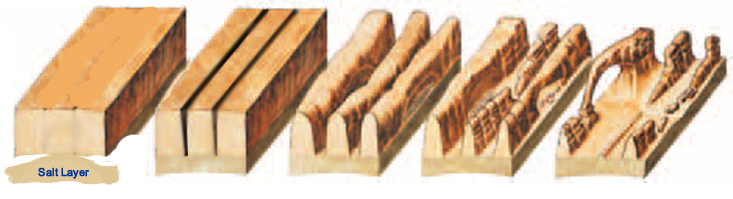
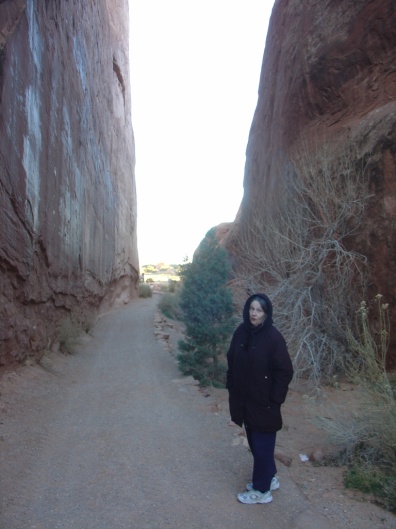
After Mother Earth created the studio over time, the artist, our Sun went to work transforming the landscape. Light absorbed by the atmosphere provided the energy to create the weather that caused the clouds of water vapor to hover overhead. With the finesse of a virtuoso violinist, the artist induced minute changes in atmospheric pressure and temperature to create local supersaturated conditions above the studio. Tiny microscopic particles in the clouds became nucleation sites for water droplets to form around until their mass increased to where they could no longer resist the relentless allurement of Mother Earth (we just call it gravity). Rain fell onto the studio, filled the cracks in the rock, started the artistry we callously call erosion, and the sculptural display began. Flowing water and time carried away the sand and widened the cracks into the narrow canyons we see today – like the one Gail is standing in on a cool December afternoon.
The rock walls between these canyons continue to erode over time and became thinner until an opening is created forming an arch or window. According to the Visitors Map and Guide, Delicate Arch is the most well known arch (also seen on Utah’s automobile license plates).
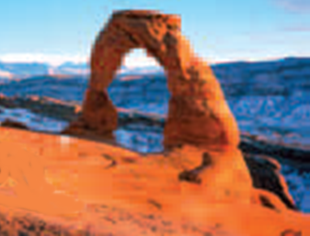
Delicate Arch
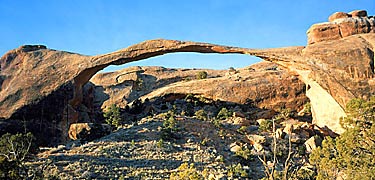
Landscape Arch
Landscape Arch, located in the park at Devils Garden, stretches over 300 feet in length and is one of the largest arches in North America.
Both the artist and the studio host embody patience. With only 10 inches of rainfall each year, the rock walls are carved so slowly humans barely perceive a change during their lifetime. Nevertheless, the sculpture continues to evolve creatively to form new arches. Using only water and geologic time, existing arches continue to be reshaped and will someday collapse to leave more carved pinnacles and spires and balanced rocks that provide the unique character of the red rock formations in Arches National Park.
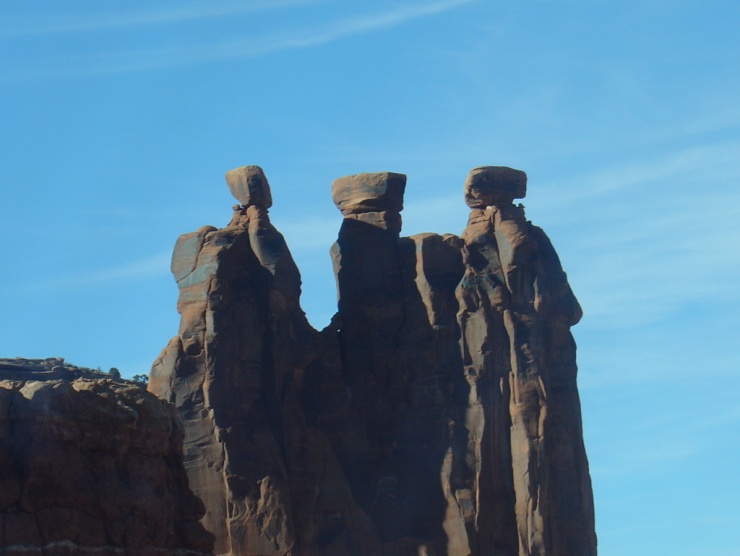
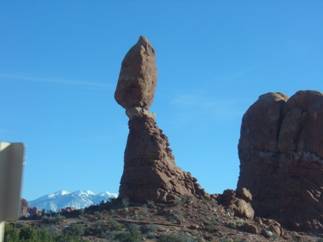
Arches National Park is located in southeast Utah at an elevation between 4,000 and 5,600 feet above sea level. Winters are cool, with low temperatures sometimes dropping below zero degrees Fahrenheit. Summer temperatures can exceed 100 degrees Fahrenheit in July and August. And human visitors are not alone in the park. Other genetic cousins persist in this arid environment including:
• 483 species of plants
• 186 species of birds
• 52 species of mammals
• 21 species of reptiles
• 6 species of fish
• 6 species of amphibians
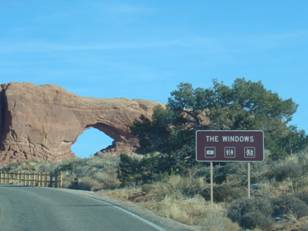
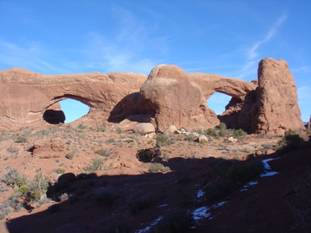
We were finishing our flame-grilled cheeseburgers and hand-cut French fries, recalling our hiking experience among the geologic wonders of Arches, when three local residents from Green River burst into Ray’s restaurant and pushed aside the relative calm. They were obviously very happy about something. The elderly gentleman was carrying a chocolate cake – still in its glass baking dish covered with aluminum foil. As they passed by to sit at the booth adjacent to ours, he kindly remarked to us two total strangers, “It’s my daughter’s birthday. My wife baked us a cake. You can have a piece too.”
We graciously accepted two pieces of deliciously warm chocolate cake topped with chocolate icing. Each piece was served on a make-shift plate fashioned from aluminum foil. We were quickly re-immersed in present human time.
It was time to head back to the hotel. As we drove over the bridge, light from our headlights illuminated ice crystals forming along the shoreline of the silent unperceivable December flow of the river below – the river that comes alive again in the spring for local business and tourist rafting enjoyment know as the Green. Back in Moab, water was also freezing and expanding in an infinite number of small cracks of the red rock, silently chipping away more arches and windows – as it has been doing unheralded for deep time.
We fell asleep filled with gratitude for thoughtful humans who protected the Arches by making it one of our 391 National Parks.
For more information about Arches National Park, see: http://www.nps.gov/arch
No Comments