Transition to sustainable living includes sustainable transportation – the topic of this segment – but first a recap of previous entries.
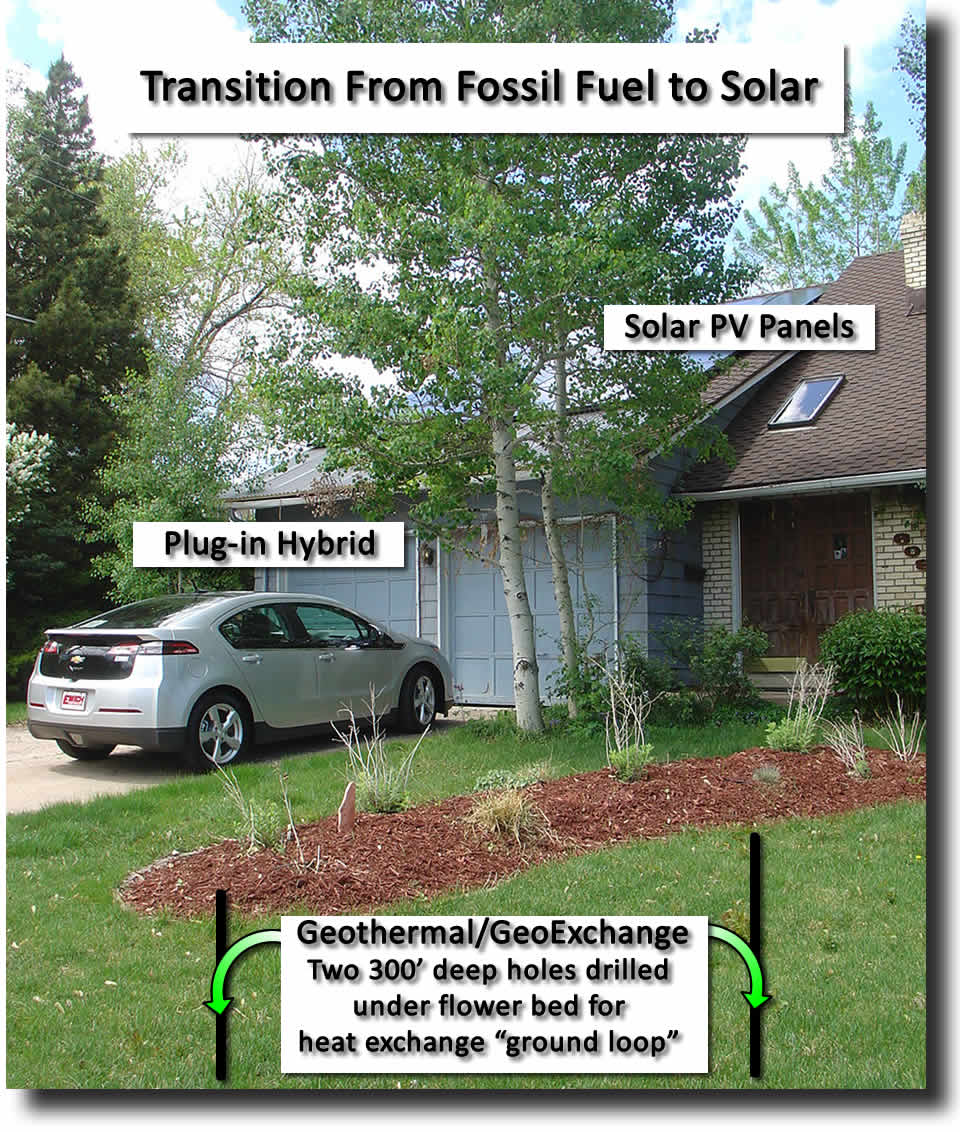
Phase I: Electricity. As you recall in June of last year we decided to become sun farmers and installed solar PV panels to harvest current sunlight and convert the sun’s energy to electrical power – enough power to operate all our electrical appliances – plus a bit extra. As a result our local public service company no longer burns coal to generate our electrical power. more…
Phase II: Heating & Cooling. Then a few months later, we replaced our natural gas furnace and traditional air conditioning unit (an air heat pump) with a geothermal /geoexchange heat pump that exchanges energy with the earth for heating and cooling. It runs on the extra electrical power we generate with the solar panels. The house no longer burns natural gas for our heating needs, so the natural gas line was disconnected. At the end of Phase II, our home operates using the Sun as its source of energy. more…
Yes, we try to be a little more energy frugal and turn off lights when we are not in the room, but in general we have not made any significant change to our life style. We still have all our “modern conveniences.” But this little experiment has confirmed that our home does not require any coal, petroleum, natural gas, or tars sands oil (and all the associated health and environmental issues associated with burning hydrocarbons) – just some natural sunlight – the same sunlight that Earth has been basking in for the past 4.5 billion years – the same sunlight that is expected to be around for several more billion years. And we only had to cover about ¼th of the roof with solar panels – so there is room for growth.
Phase III: Transportation.
Is it even possible to stop using fossil energy for local transportation? Yes! Just did it this spring.
How can I make the transition to solar power for local transportation?
We will describe one approach and some ins and outs of purchasing and operating an electric vehicle for sustainable transportation.
As more people decide to transition away from unsustainable modes of transportation that burn non-renewable hydrocarbons, more options become available. Vehicles powered by electricity allow us to build a bridge between solar energy and energy required for transportation. In 2012, car buyers now have a few electric car options available.
Background – Options Available. There are two types of “electric” cars available today.
1) The “all electric” vehicle uses an electric motor and battery but no
internal combustion engine or gas tank. Examples include: Tesla Roadster and Sedan, Nissan Leaf, and the Ford Focus Electric
2) The “hybrid” vehicle uses an electric motor/battery AND an internal
combustion engine/gas tank (i.e. an engine that burns gasoline, diesel fuel, or
hydrogen, etc.).
The “hybrid” family includes two subtypes:
2.1) the “traditional hybrid” where all the energy used to propel the vehicle is originally derived from a fuel (e.g. gasoline, biodiesel, hydrogen, etc.). An
example is the well known Toyota Prius.
This type of car can only be powered sustainably by the Sun if the fuel
it burns is linked to solar energy. (e.g. if it burns biodiesel fuel made from
plants, or if it burns hydrogen produced by the electrolysis of water powered
by electricity made with solar photovoltaic panels). Note: the traditional hybrid can be retrofitted with a larger battery and converted into a “plug-in hybrid.”
2.2) the “plug-in hybrid” where some of the stored energy used to propel the vehicle is electrical energy. The electrical power is obtained from an external source and stored in a battery – generally the battery is charged up by plugging it into a commonly available electrical source or from solar photovoltaic panels. The remaining on-board energy is derived from a fuel (e.g. gasoline, etc.). Currently the electrical energy stored in a plug-in hybrid is 5-15% of the total supply. Examples of the “plug-in hybrid” include the Prius Plug-in, Ford Fusion Electric and the Chevrolet Volt.
Personal Driving Needs.
Everyone’s driving “needs” are different; everyone’s driving “wants” are even more diverse. Today’s electric vehicle options are still limited and may not cover your driving needs. Our driving “needs” are moderate:
N1) transportation for one to two people – max of 4 people,
N2) less than 40-50 miles of driving on a normal day,
N3) capable of long cross country trips,
N4) paved roads with potholes less than 6 inches deep (intentional off-road
driving is not a priority),
N5) able to accommodate snowfalls less than 1 foot at a time,
N6) middle-class-affordability, and
N7) 5-star safety rating.
Our driving “wants” include:
W1) prefer transportation options that are made in the U.S., and
W2) want to avoid the gas pump as much as possible –want to stop consuming our decreasing supply of non-renewable fossil fuel.
Comparison of Options with Driving Needs. We think we found an option, available today, that meets our seven needs and two wants.
Since the options change each year, do re-examine what is currently available, if you decide to transition to more sustainable transportation.
Using the process of elimination, we did not choose the following options:
1) Tesla vehicles. These cars are great but pricey. $80,000 provides a 300 mile range. As the price goes down, so too does the vehicle’s driving range before it must be recharged (e.g. a $58,000 model provides a 160 mile range – great for local travel but not adequate for cross country travel). Tesla vehicles are made in the U.S.
2) Nissan Leaf and Ford Focus Electric. Would be great for local town driving, but with just over 100 mile range, neither is a viable vehicle for cross-country travel. The Leaf is not made in the U.S.
3) Plug-in Toyota Prius. The range for electrical-only driving is around 11-15 miles. Our daily driving needs often exceed this range. Although the Prius is a great hybrid, the all-electric option of their initial “plug-in” version is not as good as some of the competition. The Prius is not made in the U.S.
4) Ford Fusion Electric. Currently not available, but 2013 models go on sale in the fall of 2012. Prices have not been revealed, nor have details on the plug-in hybrid such as battery size, safety rating, electric range, or combined fuel economy. Keep your eyes open for this option.
Option Selected – Chevrolet Volt. Our particular driving needs were most nearly meet with the Chevrolet Volt. Although a bit pricey, the Federal and State Tax Credits tipped the scales in favor of the Volt.
So today we began the next phase of trying to live a bit more sustainably. There is now a “plug-in hybrid” vehicle (Chevrolet Volt) sitting in the garage formerly occupied by our trustworthy 1983 Volvo (now donated to our local PBS TV station). Not sure how many miles were on the old yellow Volvo because the odometer stopped counting years again – but I’m pretty sure it was less than 200,000.
As you probably know, the Volt runs purely off battery power for the first 40-45 miles and then automatically switches to gasoline for a total range of about 375 miles. Being retired, much of our driving is local. After 40 miles, we are generally back home and ready for a nap. So today’s plug-in hybrid allows us to drive around using electrical power generated with our solar panels powered by the Sun rather than burning gasoline we buy from oil companies.
[A post on Facebook (unverified) indicated that Jay Leno purchased an early Volt and drove 10,000 miles before having to put gas in his tank – certainly possible if your round trip commute is less than 40 miles. If you can plug in and recharge upon arrival at work, your commute could be 80 miles round trip before using any gasoline.]
But is the Volt safe? Despite what the oil and gas industry would like the general public to believe, the Volt does have a 5-star safety rating.
This plug-in hybrid uses electrical power (16 kWh of energy) that we personally can generate with the solar PV panels on our roof. During the day, we harvest current sunlight and transform the Sun’s energy into electrical energy using solar photovoltaic panels. At night, we plug-in our car to the nearest wall socket and recharge our car’s battery pack. When we wake up in the morning, we can drive another 40 miles with zero emissions (no gasoline) before the gas engine starts up automatically. Yes, it is possible to do nearly all our daily around-town-driving with no combustion of any kind required. Most of our driving uses the energy from the Sun we harvested the day before.
If you don’t have solar PV panels, you of course can recharge the battery by uying power from local utility company. At current retail rates for electricity (~ 11 cents per kilowatt hour ), it costs about $1.75 to recharge a Volt’s empty battery.
To be self-sufficient from an energy perspective, we are probably going to have to add 30% more solar panels (approximately 7-8 panels) to demonstrate sustainable transportation. After several months of real data, we will repost an update on Phase III: Sustainable Transportation.
But is an Electric Vehicle economical? Let’s do some math. In our case, thanks to our solar PV panels, the first 40 miles we drive each day is free (that’s 10,000 miles a year ) compliments of the Sun. The Volt’s warranty is 100,000 miles (battery, electric motor, gas engine, etc.) If we were to drive a gas powered car and the average gas price over the next 8-10 years is $5-$6 / gallon, we would have spent $22,000 to $27,000 on gas alone.
Let’s now compare the price of gasoline consumed (ignoring all the externalized costs of burning fossil energy) to the purchase price of a plug-in
hybrid Volt. The Volt with a few extras was around $40,000. With a Federal Tax Credit of $7500 and our State Tax credit of $6000 (your state may be different), the net cost of the Volt to us was $26,500 before taxes and plates. So we decided to trade the smell of gasoline for the smell of a new electric car.
Suppose you don’t yet have solar PV panels to charge up your electric car. Suppose you have to buy all that electrical power from your local utility company. Is an electric car still economical to operate? Here’s some math for that scenario.
A single charge of the Volt’s battery pack requires 16 kWh of electrical energy – that’s equivalent to a 2,000 watt light bulb burning for 8 hours. The typical retail price of electric is currently around $0.11 (11 cents) per kWh (kilowatt hour). It will require about $1.75 of electricity to fully charge your battery – then you drive about 40 miles without gasoline. If a gas powered car gets 40 miles to the gallon, you will use one gallon of gas priced at over $3.75 / gallon to drive that 40 miles – so today an electric vehicle effectively saves you $2.00 a gallon (50 % less). Since petroleum reserves appear to be more limited than coal and natural gas (used to generate electricity), gasoline prices are expected to increase faster than electric prices, so electric vehicle owners might expect even greater savings in the future.
Over a driving distance of 100,000 miles, if both gas and electric prices increase at a similar rate over an 8-10 year period, the electric car owner would expect to save from $7,000 to $8,500 in energy costs over the person who owns a 40 mpg gasoline car – even if the electric car owner has to purchase their electricity at retail prices. The plug-in hybrid (and all-electric cars) appear less expensive to operate than conventional gasoline/diesel powered cars.
Some ins and outs of purchasing and operating an all Electric or Plug-in Hybrid vehicle.
1) Everyone’s driving needs are different. Jot down your needs and wants before considering an electric vehicle.
2) If you have a second gasoline or diesel fueled car for long distance (greater than 100 miles) driving, then an all-electric car may be the best option for your local/city driving. If money is not an issue, be sure to check out the Tesla line of electric vehicles. If you are part of the 99%, the Nissan Leaf and Ford Focus Electric cars may be viable options.
3) If you have an occasional need for long distance driving, can’t afford or don’t want two cars, then a plug-in hybrid is worth considering. Prius Plug-in, Ford Fusion, and Chevrolet Volt may be viable options.
4) You can maximize the savings of operating an electric vehicle if you produce your own electrical power (e.g. using solar PV panels). Generally you
can produce electrical power cheaper than you can buy it from your regulated “for-profit” utility company.
5) First generation plug-in hybrids seem to be a bit pricey but Federal and State tax credits help level the playing field and compensate for all the ignored (externalized) costs of hydrocarbon burning vehicles.
The Good News!
Transitioning to sustainable transportation is possible for a number of urban drivers even with today’s first generation electric vehicles. Transportation does not require burning fossil energy as we are encouraged to believe by the gas and oil industry.
By driving a new electric car instead of our minivan, we get 10,000 miles a year of emission free transportation for the next 8-10 years. Not having to burn any coal, oil, natural gas, tar sands oil, biodiesel, bio-ethanol, wood, municipal waste, etc. – not introducing any CO2, mercury, sulfur, etc. into our common air, our common water supply, our soil just for our daily transportation seems like the appropriate way to live now that we have viable options to do so.
When you quietly zip around in your electric or plug-in hybrid car, sit back and enjoy this ingenious human creation. Know you are living more sustainably and more ethically for the well being of future generations. Know you are no longer consuming our one-time-only fossil energy for your transportation needs. Know you are no longer contributing to climate change and its dangerous weather extremes. If you decide to go electric, big oil and gas companies will not like you, BUT all life on Planet Earth will thank you (as will your grandchildren and their children and all generations to follow).
We just need the Sun to continue to shine like it has been for the past 4.5 billion years.
A word of CAUTION. The Chevrolet Volt is a sweet car to drive. It’s quiet, it’s zippy, it’s handles superbly. No wonder it was at the top of the list in Consumer Reports’ car owner-satisfaction survey for 2011. If you test drive one, there’s a good chance you may want to buy one. So use caution. More…(specific data such as mpg, etc.)
So what’s next? This summer, we plan to move on to Phase IV of Sustainable Living and learn more about Food Production, so stop back later.
Links / References
1) “Battery cars face an uphill climb to acceptance”. http://bottomline.msnbc.msn.com/_news/2012/01/06/10010063-battery-cars-face-an-uphill-climb-to-acceptance?lite
2) Volt’s 5-star safety rating – SaferCar.gov. http://www.safercar.gov/Vehicle+Shoppers/5-Star+Safety+Ratings/2011-Newer+Vehicles/Search-Results?searchtype=model&make=CHEVROLET&model=VOLT&year=2011
3) “Chevrolet Volt Tops Owner-Satisfaction Survey” http://www.autoobserver.com/2011/12/chevrolet-volt-tops-owner-satisfaction-survey.html
No Comments