In Part #1 of this post, we discussed our purchase of solar powered LED colored lights. We included a brief description of how this human creation harvests current sunlight during the day, converts this light energy into electrical then chemical energy stored within a battery so it can be released after nightfall to create colored light – all this just so we can celebrate the joy of the holiday season..)
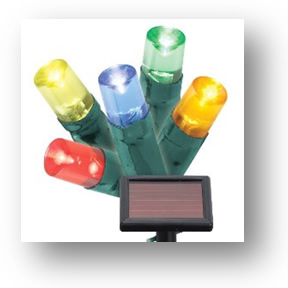
We observed that this cute human creation, (another example of cosmic emergence: ‘something-more-from-nothing-but’ as a consequence of new relationships) is able to burn brightly without using more Ancient Sunlight; without using more precious water; and without dumping more carbon dioxide into the atmosphere.
In Part # 2, we will continue to reflect on this ‘string of 50 colored LED lights’ now dangling on the wrought iron railing atop the court yard wall in front of Gail’s house – for all to see.
As typical volunteer spokespeople for the awakening consciousness of the Earth, we have to wonder, ”is it appropriate to replace our simple sentimental incandescent bulbs and the extension cords we have been plugging into the same electrical socket for decades with these new more complex solar powered LEDs?” After all, the green label on the box says “100% Energy Savings. No Electricity Cost.”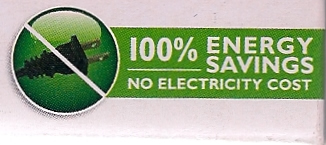
From an outward appearance, the use of solar powered LED colored lights appears to be sustainable. Lights using the Light Emitting Diode (LED) technology consume only 20% of the electrical power needed for the old fashioned incandescent lights – so LEDs certainly conserve energy and solar powered lights appear to be in the direction of sustainability – BUT are they really? Is this latest commercial product in ‘Right Relationship’ with the Earth – with the Universe?” Is this latest emergence something we expect to see 1000 years from now in a more conscious civilization, a period after we and our children have consumed all the Ancient Sunlight (oil, coal, natural gas, etc. )?
Question: Are Solar Powered Lights Appropriate in the Context of Sustainability?
Using the collective awareness provided by fellow humans (i.e. the readers of this blog), we want to exercise our current level of collective consciousness and hopefully together we can begin to answer this question.
Answer: It’s complicated
As you already know, the answer is complicated. But let’s start the dialog with a few observations to gain a bit more insight into what the answer might look like if we had more knowledge and wisdom.
Why do we feel a need to celebrate at this time of the year? Why are lights a part of this celebration? What is the impact of buying and using solar powered colored lights? Are solar powered lights sustainable?
Responding to these and other questions may allow us to explore a number of issues we consumers face as we make everyday decisions in this period of peak oil and climate change.
Why do we feel a need to celebrate at this time of the year? (Northern Cold Solstice- Southern Warm Solstice)
Even though our solar system is approximately 4-5 billion years old and the earth has been making this annual journey around the Sun for just about as many years, our early human ancestors around the world sensed the changing seasonal light and responded – as do our non-human cousins.
For example our ancestors who lived in the northern hemisphere may have observed what appeared to be the noonday Sun falling from the sky during this time of year (as it appears lower and lower in the southern sky approaching solstice.) Possibly out of fear, they attempted to intervene by performing some type of ritual or ceremony or sacrifice to the Sun god to entice it back to its position in the noonday sky. We do know from archeological findings our ancestors were very aware of the Sun, moon and stars by their calendars and stone diaries of the Sun’s motion (e.g. Stonehenge[1], Chaco Canyon, etc.) Even today, in the Common Era, there are an estimated 100 such “observances” and “festivals” linked to the solstice and this time of the year. Let’s face it; we humans are real party animals.
With today’s awareness, we understand the perpetual annual (seasonal) change is related to the 23.45 degree tilt of our Earth’s axis relative to our orbital plane around our Sun. Although our “tilt” remains inertially constant relative to the Universe (it’s a conservation of angular momentum thing- some would call it the gyroscope thing), as we make our annual elliptical (nearly circular) trip around our Sun, northern hemisphere inhabitants feel (and they are) pointed away from the Sun. Southern hemisphere cousins sense they are pointed more toward the Sun (and they are). Then about 6 months later we all feel we have changed places (and we have).
Not to fear. We will probably be here doing this seasonal dance with the Sun for several more billions of years. But if we still want to give our offerings to the gods of commercialism to assure the Sun comes back, they still accept cash, check and credit cards.
Why are lights a part of this celebration?
What’s the deal with colored lights? Why do some of us in the Northern Western world feel compelled to drag out, hook up and display strings of lights this time of year?
According to Edna Barth, “some form of light has marked all human’s occasions of joy…”
 In her book, Holly, Reindeer, and Colored Lights: The Story of the Christmas Symbols, she states: “Holly and reindeer, angels and stars, trees sparkling with colored lights. Weeks before Christmas, these and other holiday symbols appear all around us. Each of the symbols has a story. Many of them go back to the first Christmas or long before. And each of them has a special meaning for us today…..
Centuries before the birth of Jesus, people lighted torches as well as bonfires at their winter solstice rites….
Before modern electricity, candles had also decorated Christmas trees. Now trees are usually strung with colored lights, and sometimes they decorate whole houses or whole streets. On rooftops and front lawns there are lighted tableaux of Christmas figures from Santa and reindeer to the entire manger scene. The American Christmas is a feast of lights….”
…”Some form of light has marked all human’s occasions of joy…” We find a deeper meaning in Barth’s observation when we reflect on the Universe Story – how from Light emerged elemental matter (quarks, bosons, etc.) then from elemental matter emerged basic matter (hydrogen & helium atoms), from which emerged more complex atoms (carbon, oxygen, etc. see periodic table) from which emerged molecules (H2O, CO2, …. to RNA, DNA), from which emerged living cells, from which emerged living organisms and us. We along with every other living organism on the planet are “children of the Light.” We humans are the current path by which Light is transformed into consciousness. After 13.7 billion years. Is it no wonder that Light is associated with joy?
What is the impact of buying and using solar powered colored lights?
We recognize that manufacturing the solar powered lights and shipping them to the local Target store had an impact on the Earth. Can we describe and then quantify this impact?
Gail and I are not trying to emulate the “No Impact Man” as did Colin Beavan recently. For one year, he, his wife and baby daughter, while residing in Manhattan, attempted “to live without making any net impact on the environment.” To Mr. Beavan, this meant they did their best to create no trash (so no take-out food), cause no carbon dioxide emissions (so no driving or flying), pour no toxins in the water (so no laundry detergent), buy no produce from distant lands (so no New Zealand fruit), no elevators, no subway, no products in packaging, no plastics, no air conditioning, no TV, no buying anything new…. His experiences during that year are documented in his 274 page book made of 100 % postconsumer recycled paper and cardboard, processed without chlorine, manufactured using energy from biogas. “No Impact Man” is an entertaining and informative read with a motivational Appendix: You Can Make a Difference that contains tips on environmental lifestyle redesign in response to the crisis in our habitat. See also www.NoImpactMan.com
As do all living species, during the year, Mr. Beavan and family continued to consume oxygen, water, take in energy in the form of food and expel by-products (e.g. carbon dioxide with each breath, liquid and solid waste). With all due respect to Mr. Beavan, “No Impact” is synonymous with death and probably not an advisable goal for a species trying to avoid extinction. Nevertheless, Mr. Beavan admirably demonstrated how to become the “Low Impact Man.”
Rather than striving to have “no impact”, we’d like to suggest a more meaningful objective might be to become conscious enough to live in ‘right relationship’ with Earth in a manner that is sustainably beyond a few hundred more years. Actually the Universe Story suggests we think of sustainability not in terms of hundreds of years but in thousands and millions and billions of years. Our Sun, our real source of life and therefore our hope for further evolution appears to have agreed to be around for several more billion years. And at this moment, we don’t see any asteroids on a collision-course with Earth. Because we have evolved to have free will, it becomes our choice to be in right relationship with the whole of life on this planet. Because we have a choice, it becomes our responsibility to be aware of our impact, to live sustainably (e.g. avoid using ANY Ancient Sunlight unless it is used to avoid future use of Ancient Sunlight, etc.) and in general to grow in consciousness in support of further evolution.
At this point we are partially aware of the impacts of purchasing solar powered colored lights. We suspect that as the clerk rang up our purchase, the UPC number was identified and another unit was back-ordered to replace the one we took off the shelf and purchased. Manufacturing a replacement unit may have already started.
Material Impacts
- Manufacturing the lights did consume Ancient Sunlight (oil, coal, gas, etc.)
a. Oil and natural gas were consumed as the raw materials to produce the plastic insulation on the electrical wire
b. Ancient Sunlight was probably used to make the glass used on the solar panel - Manufacturing the lights did dump by-products into the air and possibly water ways
- Manufacturing the lights did consume natural resources (e.g. copper, silicon, wood for paper, misc chemicals for printing dyes, …)
- Transporting the finished product from China to the U.S. and placing it on the shelf at the local Target store did consume Ancient Sunlight and dump green house gases into the atmosphere
- Our 12 mile round trip drive to the local Target Store in Gail’s Prius @ 50 mpg did consume 0.25 gallons of gasoline (~ 7200 calories) of Ancient Sunlight and dump green house gases into the atmosphere
- Over the next 5, 10 , 15 years we plan to use these colored lights, we will not be consuming any more Ancient Sunlight, water and other natural resources, or be responsible for dumping waste products into the air or waterways/oceans
Using today’s analysis and research tools and methodology, it is possible to reconstruct the “process” used to extract Earth’s resources and fashion them into this new creation called “solar powered LED colored lights.” After identifying the steps in this human controlled process that assembled Earth’s atoms into the form found on the shelf in our local Target store, it is possible to use extensive databases and perform a Life Cycle Assessment (LCA) of the material aspects of the product to quantify its impact on planet Earth. This assessment quantifies the key parameters important to consider when focused on the sustainability of creating ‘something-more-from-nothing-but.’ Information that emerges from an LCA include: amount of Ancient Sunlight consumed, amount of water consumed, quantity of CO2, sulfur dioxide, NOx, etc released into the atmosphere, etc. Completing an LCA for the solar powered LEDs is possible but requires access to the appropriate tools and databases – which we do not have at the moment, but plan to pursue in the future.
Social Impacts
It is possible to extend the Life Cycle Assessment to include social impacts. It’s referred to aptly as a Social Life Cycle Assessment (S-LCA). Our purchase of this product transferred some of our wealth into the hands of others and impacted their lives – whether or not this small redistribution of wealth was fair or just is unknown.
- Target (local employees, upper management/CEO, stockholders, …)
- Advertizing media (newspapers, TV, etc. )
- Seasonal Specialties L.L.C. (importer)
- Philips (licenser of the product)
- Chinese manufacturing personnel
- Lower tier suppliers (plastics, glass, copper, LEDs, electronics,…)
- Transportation personnel (ships, trucks, planes, …)
The profit margin on this item was over 100% because the item sold for $20 before the holidays and for $10 in after Christmas sales. We assume the majority, if not all of the $10 retail profit went to Target stakeholders and little to Chinese manufacturers. It is not clear how we can obtain more economic data to better assess the ‘Social – Life Cycle Assessment (S-LCA).
Conclusion – Cosmological Significance of Solar Power Lights
Today, humans can harvest the energy of current sunlight, change it into electrical and chemical forms, store it and use it later. We are now able to collect today’s sunlight and save it until evening (or the next day, next week) and then send it back out to the Universe. But to do so comes with a cost to the planet.
The creation of Solar Powered LEDs is certainly in the direction of creative complexity – another example of emergence – of ‘something-more-from-nothing-but’ as a consequence of new relationships. Given the initial expenditure of Ancient Sunlight and other resources, the celebratory lights no longer need to consume Ancient Sunlight or water or put carbon back into the atmosphere – these are good things.
We attempted to reflect on the emergence of ‘solar powered LED colored lights’ to determine if this new creation invented by human consciousness was in the direction of sustainability.
We found there is insufficient information provided with the product to make an informed consumer decision, so we set out to conduct our own assessment. We found it is possible with today’s awareness and consciousness of how humans impact their planet to actually quantify the one-time-impact of producing this new item. Given access to the appropriate tools and databases, it would be possible to assess the material and social impacts and provide that information to the consumer (similar to how food ingredients are listed and quantified on each and every food item sold in the U.S.)
When we purchased this consumer item, we voted (with our purchasing power) to maintain a niche for this latest emergence without a clear or complete understanding of its true sustainability. This is not setting a good example and is not something we recommend.
As consumers, if we knew the planetary impact, then we could decide if we were willing to be responsible for putting the Earth back into right relationship for the amount of Ancient Sunlight we caused to be consumed, for the amount of CO2 we caused to be dumped into the atmosphere, etc. More on this in later blogs…
- Whatever religious, mystical or spiritual elements were central to Stonehenge, its design includes a celestial observatory function, which might have allowed prediction of eclipse, solstice, equinox and other celestial events important to a contemporary religion [20] G. S. Hawkins Stonehenge Decoded 1966.ISBN-10: 0880291478 ISBN-13: 978-0880291477 http://en.wikipedia.org/wiki/Stonehenge
I am really diiging these solar powered, colored light posts!